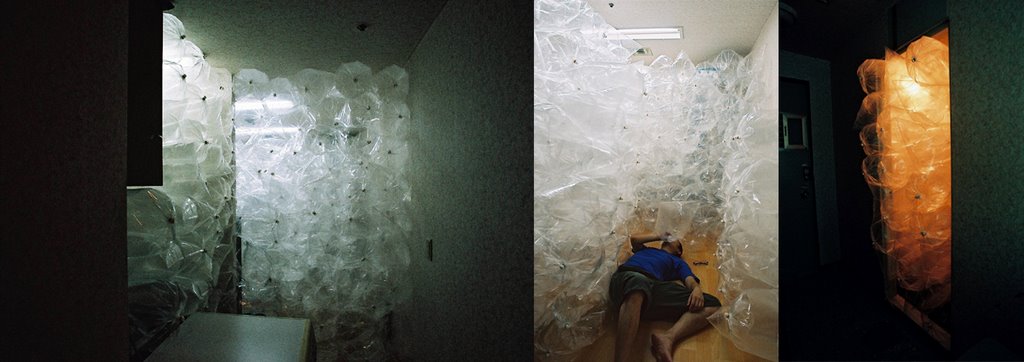
Mapping the mental perception in a space.
Perception
Pronunciation:
/pəˈsɛpʃ(ə)n/
noun
·
the ability
to see, hear, or become aware of something through the senses: the normal
limits to human perception
·
Psychology & Zoology the
neurophysiological processes, including memory, by which an organism becomes
aware of and interprets external stimuli.
·
the way in
which something is regarded, understood, or interpreted

In presenting context writing I mentioned about Repetition in relation to an approach to a new way of thinking. By describing different contexts, I shown how different senses can affect one’s perception; I suppose I was trying to say, repetition suggests time is no longer important but its existence. A new perception is extended from an autonomous perception. Which I have found its similarity to Buddhism thinking, but here I would like to focus on Carlo Bernardini’s work and using Buddhism as a lens to see his work, and open it up with questioning how does these affects the relation of the work and viewers’ perception.
“ Shadow and
light are visible, although both are formless. Shadow is the dark projection of
things. It occupies the other side of matter, increasing the perception of its
existence, while remaining evasive and uncontainable.”[1]
Carlo Bernardini has high awareness of the relation of ‘Light and shade’; shading enhances
objects’ existence, shadow tells us information of what it belongs to, take an
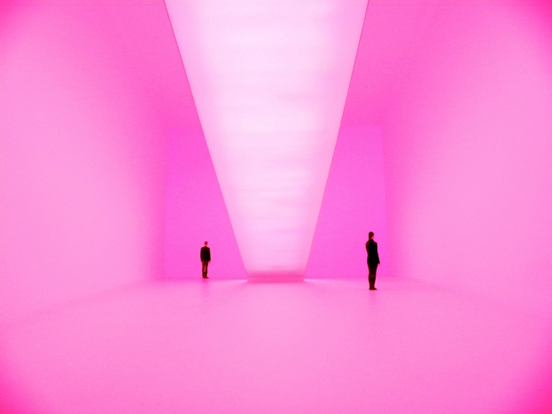
example of one of Bernardini’s work (the above pictures), ‘PROGRESSIVE CODE OF THE SPACE ‘2009 shows the relationship
between light and shadow, and transforming to the further stage: the mental
side of the artist, his perception of seeing in a space. The triangle electroluminescent surface and its shadow are
corresponding to each other within a shape, but the optic fibre ‘light lines’
are showing the ‘second visual condition’ that jumps out from the primary
vision (2D), giving viewers an infinite points of observation, that travels
perceptively around the space.
Benardini almost takes down every physical representation, using
light lines as the ‘betweener’ of light and shade, as it were, just like what
Buddhism believes its existence is located between the ‘Self’ and the nature.
Self means realization;“Whatever we see is changing, losing its
balance. The reason everything looks beautiful is because it is out of balance,
but its background is always in perfect harmony. This is how everything exists
in the realm of Buddha nature, losing its balance against a background of
perfect balance. So if you see things without realizing the background of
Buddha nature, everything appears to be in the form of suffering. But if you
understand the background of existence, you realize that suffering itself is
how we live, and how we extend our life.” [2]
The realization from the perception in Buddhism is an experimental approach to the understanding of the universe, in order to perceive everything from the emptiness, the beginning. It is an on-going life practice; we discover, understand, realize through experiences and most importantly, standing in a position that assuming not knowing at all. Similarly, Bernardini’s mysterious visual language is in a way showing the basic autonomous idea of light and shade; his own understanding of it is immaterial, attempting to approach the unknown area that is always existed invisibly. His works push against the limit of perceptions; a different position with different viewpoints, to see the whole view is to step outside of the work.
The realization from the perception in Buddhism is an experimental approach to the understanding of the universe, in order to perceive everything from the emptiness, the beginning. It is an on-going life practice; we discover, understand, realize through experiences and most importantly, standing in a position that assuming not knowing at all. Similarly, Bernardini’s mysterious visual language is in a way showing the basic autonomous idea of light and shade; his own understanding of it is immaterial, attempting to approach the unknown area that is always existed invisibly. His works push against the limit of perceptions; a different position with different viewpoints, to see the whole view is to step outside of the work.

He once stated that corresponding the above idea; “In the visual Language between us and that
part of us that emerges in image there is a no man’s land whose secrets we
endeavor to find out… In such conditions the intrinsic interest of the images
does not, therefore, lie in metaphorical or allusive aspects, but solely in its
purely visual value, beyond which there may be nothing.”[3]
This again shows that the notion of invisibility and thoughts provocative from
visual essences.
‘Division of visual unity’ 2000] intrigues me to investigate Bernardini’s
way of thinking, which based on his belief of art practice is not a ‘result’, a
river that never stops moving. His works is static but with a notion of dynamic
repetition, an endless journey from centripetal to centrifugal. ‘Division of
visual unity’ 2000 is a sculpture with stainless steel and optic fiber, the
former is visible by day and the latter is visible by night. At the moments when the sun becomes to
set, the work immerses into a piece; Bernardini is asking viewers to combine
the inner and outer as a whole, or to look at it from the external then moving
to the internal, Vise Vera, until when there is sunrise again, a relative
perception in terms of repetition. “ This
process of form fading to give birth to other forms is of course reversed at
sunrise”[4],
the artist has inserted a poetic and immaterial concept with the infinite rule
of nature within the work.
I found this similar to another medium: looping moving image; both of them are not mattering when you will see it, it matters if you stay longer with them, and realize something that are essential and the subtle changes, to gain knowledge from not knowing when is the start and the end. It is also playing around with the idea of expectation; Bernardini’s outdoor sculpture gives viewers different unique sensations, therefore every time the work looks different; since the work is located outside, with different sky, or amount of people, etc. Repetition provides infinite possibilities of interpretations; with a different context, the space becomes the environment. The particular point of observation is depending on the movement from viewers. “Every viewpoint becomes internal to the totality of the work: it may take in the global installation or close in on details of the structure with superimposition and fragmentation, possibly even losing sight of the whole.” This notion of being lost in an almost timeless and measureless space is somehow coincide with the emptiness idea in Buddhism. Every part of the work is a totality of itself and a totality as an installation; the artist is blurring the line between sculpture and installation, a sort of space in a space, this helps to approach to the mental endeavour of the artist.
I found this similar to another medium: looping moving image; both of them are not mattering when you will see it, it matters if you stay longer with them, and realize something that are essential and the subtle changes, to gain knowledge from not knowing when is the start and the end. It is also playing around with the idea of expectation; Bernardini’s outdoor sculpture gives viewers different unique sensations, therefore every time the work looks different; since the work is located outside, with different sky, or amount of people, etc. Repetition provides infinite possibilities of interpretations; with a different context, the space becomes the environment. The particular point of observation is depending on the movement from viewers. “Every viewpoint becomes internal to the totality of the work: it may take in the global installation or close in on details of the structure with superimposition and fragmentation, possibly even losing sight of the whole.” This notion of being lost in an almost timeless and measureless space is somehow coincide with the emptiness idea in Buddhism. Every part of the work is a totality of itself and a totality as an installation; the artist is blurring the line between sculpture and installation, a sort of space in a space, this helps to approach to the mental endeavour of the artist.
Light as the intangible source, it always exists with an object
and the shade. Bernardini takes away the physicality and shade, only leaves the
light in his work; thanks to the technology of optic fiber that looks like a
line is self- illuminated. I can imagine if I am in his installation ‘PROGRESSIVE CODE OF THE SPACE ‘2009, I will be
immersed in it and keep questioning myself how would those lines be lighten up,
and where are the light sources? Is it an illusory? I remember John Berge has
mentioned in his book ‘Ways of seeing’: “ We never look at just one thing, we
are always looking at the relation between things and ourselves.” [5]
If I were in the installation, can I see myself as the shade of those lights?
Or how should I address myself as an audience of the artist’s mental stage? If
I were the artist, how would I visualize my imagination to viewers? And how
would they visualize mine from the work I made? I suppose these questions would
most likely to be raised when I am out of the installation; an immersive
installation won’t let audiences to reflect or even think, it is a strictly
delivery of the artist visual, immaterial mind. We as viewers will only think
of those questions when we are out of it as we might start to have awareness of
once being lost; and the solution might be to try thinking like the artist, to engage
in the artist’s perception, and transforming it into ours. But in Bernardini’s
works, the perceptive options are open; this implies the interactive
opportunity of mental by physical movement or vision.
I suppose it never comes to an end when talking about a mental
situation, because it is always changing. Space affecting man’s feeling,
sensation physically and mentally; therefore perception is changed. Viewers
stepping into the installation, as if being mapped in the artist’s brain; walking
around and thinking the relation between themselves and the work, wondering
what will happen when stepping out of the work, would it change the way we see
in the reality?
“The viewer’s response to a work’s presence is sometimes dependent on the work’s familiarity, its resonance with our own experience. Yet it is also at times its unfamiliarity that has the most profound impact on our experience. “To some degree we become artists ourselves as we undertake this integration,” John Dewey tells us about perceiving something that stands beyond the realm of what we know. Through perception “our own experience is re-oriented.” And it is this experience that is “far more efficacious than the change effected by reasoning, because it enters directly into attitude.” Experience of art can be transformational experience.”[6]
“The viewer’s response to a work’s presence is sometimes dependent on the work’s familiarity, its resonance with our own experience. Yet it is also at times its unfamiliarity that has the most profound impact on our experience. “To some degree we become artists ourselves as we undertake this integration,” John Dewey tells us about perceiving something that stands beyond the realm of what we know. Through perception “our own experience is re-oriented.” And it is this experience that is “far more efficacious than the change effected by reasoning, because it enters directly into attitude.” Experience of art can be transformational experience.”[6]
To refer back to the Buddhism thinking, to achieve a greater thinking
is to go beyond the physicality and the experiences; experiences can tell us
what are the mistakes we wouldn’t want to make again. The area is very far away
from the reality, but the practice of us or like art practice of artists can
help us to go closer or get to the direction to it. What Bernardini is making
is only the process to an unknown mental stage that his intuition drives.
Bibliography
Bass. J and Jacob M, 2004, Buddha Mind in Contemporary Art, University of
Carlifornia Press
Berge. J, 1972Ways of seeing, BBC
O.F Bollnow, 2011 Human Space, Hyphen Press
Artist Writing, http://www.carlobernardini.it/File_uk/TESTI_INGLESE/WRITINGS_OF_CARLO_BERNARDINI.pdf
[accessed on 2.4.2012]
Critical Essays,
http://www.carlobernardini.it/File_uk/TESTI_INGLESE/CRITICAL_ESSAYS.pdf
[accessed on 2.4.2012]
Cora. B, 2009, Carlo Bernardini: Space Designed by light
Caramel. L, 2006, The other side. The perception of the invisible
and the immaterial
Ferrario. R, 2003, Light works/Light sculptures
Perilli. N,2003 Light system